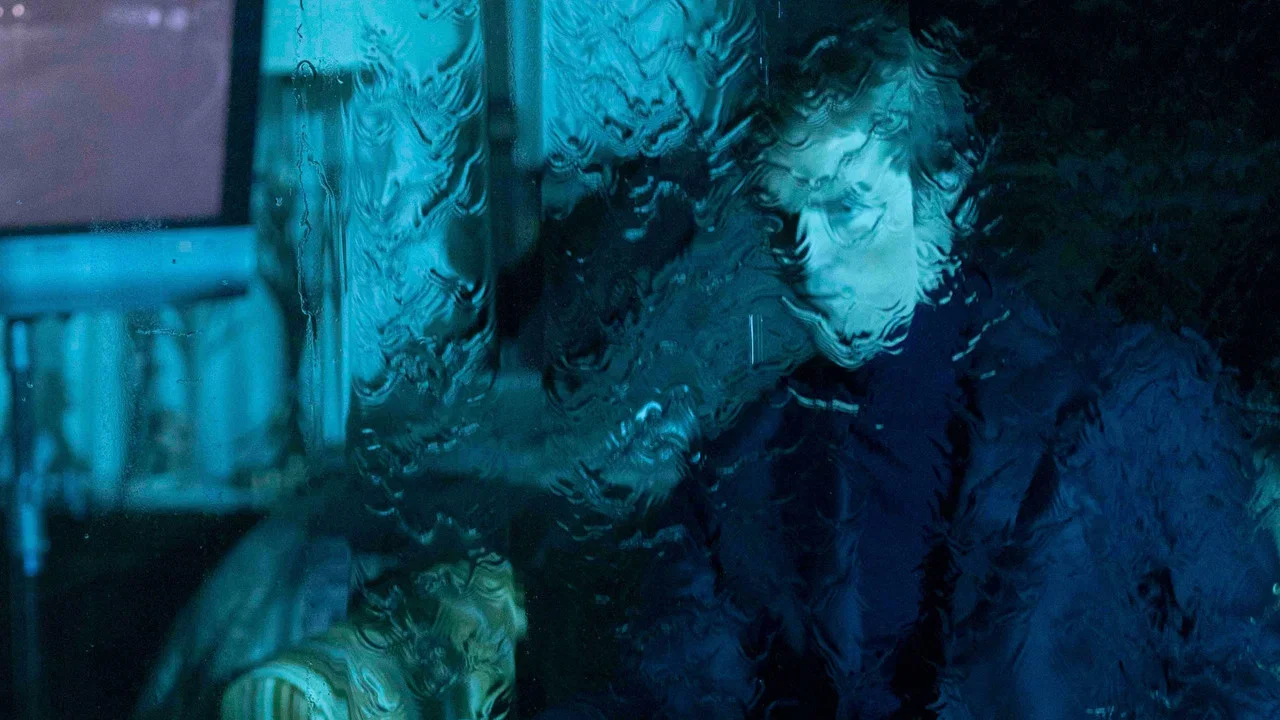
You Can See Everything

Did a scammer scam a scammer, or did the scammer scam everyone?
A new epic, an absolute surprise and a shock from A24, Nathan Fielder, and Lance Oppenheim, You Can See Everything is an event, to say the least.
This documentary about Elizabeth Holmes, a woman I think pretty much everyone who has had access to the internet over the last ten years is familiar with, tells the story of one of the most infamous fraudsters of our generation and her company, Theranos. It follows her and her partner in the weeks leading up to her departure for a Texas prison, where she was supposed to begin serving her eleven-year sentence. Nathan Fielder takes it upon himself to interview and physically live with the couple during this time, managing to have some heartfelt conversations while also witnessing a series of personal, strange, and incomprehensible moments in an attempt to understand Elizabeth Holmes's logic, the logic of her partner Billy Evans, and ultimately, to uncover the truth and find some grain of it. He also tries to understand why Elizabeth still refuses to admit that she has done anything wrong.
I am not going to recount the plot of this documentary because I genuinely believe everyone needs to experience it for themselves. The emotions and feelings you experience while watching are incredibly difficult to describe because you are looking at something that simply defies rational explanation. This is not just a documentary, nor is it simply a narrative feature. It is an incredible combination of absolutely everything: documentary filmmaking, investigative journalism, drama, and some kind of twisted noir. Believe me, if a packed cinema full of journalists, where I watched this film, remained so quiet throughout its three-hour runtime that people were afraid to even cough, that tells you a lot.
Because ultimately, You Can See Everything is not a documentary about Elizabeth Holmes. Yes, she is there. She tells her story, and part of the film is indeed a documentary about her. But at some point, it becomes more about her partner, Billy Evans, and his absolutely nasty insanity. Yet even that is not the real point of the film, because then we move into another part of the story, where Nathan Fielder and his team attempt to understand what they have witnessed and continue digging into what they saw, what it all means, and where the truth actually lies. Various people, whom you will see on screen, help them along the way.
And eventually, the film becomes a documentary about society, the media, how we process information, and psychology. It becomes a genuine psychological thriller about how susceptible we are to the media and what it projects onto us, as well as what other people try to project onto us, which is often far from the truth. It is about how another person's mind is a complete mystery. At times, it is a comedy because you simply cannot help laughing at what you are seeing on screen. It is also a horror film because there are moments when you genuinely get goosebumps. Ultimately, You Can See Everything is a chase after a truth that does not exist.
This is the story of a woman who managed to charm a whole bunch of investors and eventually sell them a product that, essentially, did not exist. But she also managed to charm the very person who came to uncover the truth about her and get to the bottom of who she really was. And at some point, Nathan Fielder himself becomes the subject of his own documentary, questioning his own objectivity. Other people in the film question it, too, while their own motives become far from transparent in return.
Then, in the second half, when the focus shifts to Billy Evans, Elizabeth Holmes's partner and the father of her two children, we begin to delve into his narcissistic world as a right-wing Charlie Kirk fan who hates women, considers himself superior, and uses his partner's love for his own purposes while remaining free. He turns out to be an absolute asshole who has literally hijacked her words, thoughts, and ideas and uses them for his own benefit. Meanwhile, Elizabeth Holmes appears to be suffering from Stockholm syndrome, blindly in love with her abuser. But even that eventually comes into question, because we are left in such a state of uncertainty that it begins to feel as though this has all been one enormous game played by both Elizabeth and Billy. A game designed to make absolutely everyone question everything, to present her in a more positive light and portray her as a victim, even though she might actually know exactly what she is doing.
You get so completely lost in all these twists and turns alongside everyone involved in making this film. While the people on screen stare at one another — and there is A LOT of staring in this film — you are desperately trying to activate mechanisms in your brain that simply did not exist before. The confusion experienced by absolutely everyone involved, both those in the film and those watching it, is something else entirely.
The confrontation scene between Billy Evans and one of the film's guests (whose name I won't reveal in case some of you managed to dodge the spoiler) is absolutely batshit crazy. Out of this world.
And then we reach the point where the filmmakers themselves start speaking in the same vague, carefully constructed language that Elizabeth Holmes used to make people believe in her and her product. Even though you kinda feel like she is genuinely sincere and actually believes what she is saying, the real catch lies in how she says it and the words she chooses to use. And by the end, even Fielder is starting to copy her because it does make sense in the moment, just not afterwards, when you have time to analyze what was said.
This codependency among the people surrounding this story feels like a complete breakdown of the boundaries between a character, a person, a director, a journalist, and a documentarian. Because ultimately, Nathan Fielder puts himself in the line of fire to make a point: we have all become completely lost in a world of other people's words and their perceptions.
Do I think this documentary will revolutionize the genre and open a new chapter in documentary filmmaking? No. But only because I believe making another film like this would be practically impossible right now. Everything came together here: absolutely incredible subjects whose psychology could probably be the topic of some great scientific study, and an extraordinarily unconventional approach to the subject matter. Replicating something like this on this scale seems unreal, at least for now.
That is why I believe that, at this point, You Can See Everything will be the unicorn of the film world.
The way this film has stunned everyone around it genuinely has a point. You arrive having already heard the most overwhelmingly enthusiastic reviews imaginable, and you cannot understand how a documentary could possibly be so otherworldly. Then you watch it and realize that the filmmakers have managed to create something you have never seen on screen before. And in today's world, that's a miracle.
The presentation, the absolutely incredible editing, the conversations, the moments of laughter when the tension is allowed to ease, the suspense, the story, the sheer scope of it all, and Nathan Fielder's absolutely outstanding work — there is something so uncanny and beautiful about this film that you have no choice but to applaud everyone involved.
Incredible.
10/10