Aldous Harding - Train on the Island

Confounding and absurd, curious and utterly enchanting, Aldous Harding’s fifth studio album stands as one of the most significant folk releases of this year.
Some albums captivate from the very first listen. They do not need to be immediately accessible or as transparent as an open book. Their power lies in their mystery — and that is exactly what defines Harding’s fifth album. Blending traditional folk motifs with chamber pop, Train on the Island invites repeated returns, rewarding listeners who are willing to lose themselves in its sonic landscapes and cryptic lyrics.
“I’ve been away too long”, Harding sings on the lead single “One Stop”, a tense piano-driven composition. She is not exaggerating: the predecessor to Train on the Island, Warm Chris, was released back in early 2022. A great deal has changed in the music world since then, but Harding’s artistic principles remain firmly intact. Her songwriting continues to astonish with lines that often sound strange, if not completely nonsensical. In the same song, she boasts that she met John Cale, though he refused to speak to her because she was eating rice backstage. On the second single, “Venus in the Zinnia”, she casually remarks that no one likes her new haircut.
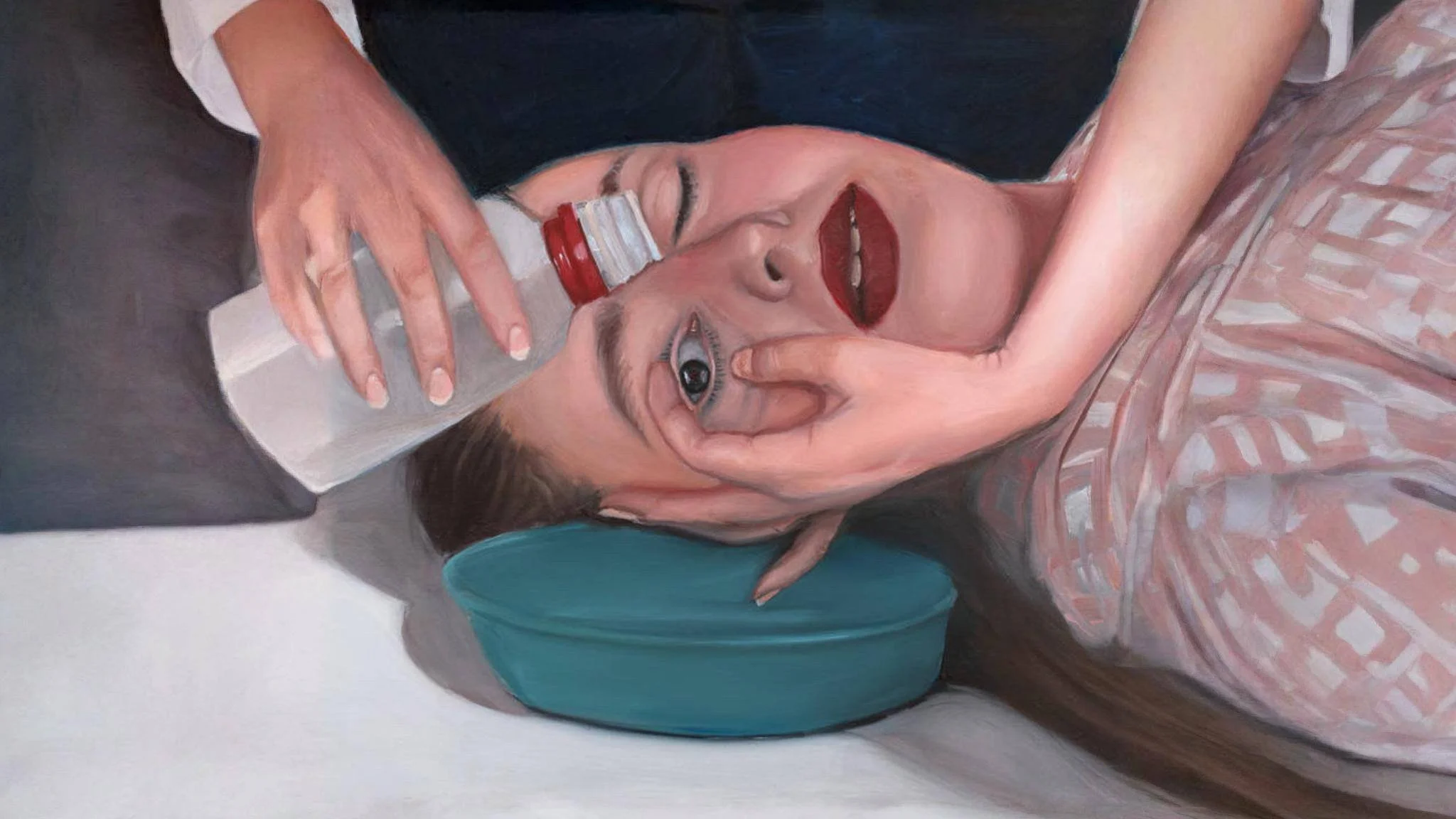
This lyrical game of guesswork begins from the opening moments. The first lines — “I’m not afraid like you’re not gay and you’re not old, like I’m on the spectrum” — may immediately disorient an unprepared listener. From there, the album only grows more enigmatic. On “I Ate the Most”, Harding compares relationships to disordered eating and love to a lemon, eventually admitting that romance can become nauseating. Much of the album’s appeal lies in the impossibility of predicting where her thoughts will go next. “I’m saving myself by eating rocks and plants / I pray for the incel”, she declares on the slow-burning guitar piece “Worms”. By the final stretch, Harding seems determined to dismantle the listener’s expectations entirely, breaking the fourth wall to ask what she should say to the blue-faced woman — a direct reference to the album cover, where she sits in a university lecture hall with her face painted blue.
Yet it would be a mistake to dismiss the record as pure fever-dream nonsense. The opening track contains a line that captures the emotional weight of contemporary life with remarkable clarity: “Every day I look up in my body / There’s heavy and heavier”. This sense of mounting pressure gives the album a surprisingly profound emotional core. The often solemn and imposing instrumentation only intensifies that feeling. You may not always understand precisely what Harding means, but the instinctive reaction of “yes, I feel that” arises again and again.
The title track evokes a similar response. Warm and enveloping, it acts as a gateway into Harding’s singular universe — a place where philosophical reflection coexists with playful whimsy. She conjures images of Sicilian beaches and deserted streets in San Francisco, runs across a bridge in the middle of the night, and openly cries out for the chance to see her lover.
The entire album is woven from these peculiar but evocative details. Harding imagines herself as a spark in the ocean, reflects on motherhood and childhood, likens herself to a buffalo in spring, and dresses her characters in oversized coats. At times, this imaginative approach recalls the most adventurous moments in the catalog of Fiona Apple. Is this an easy album to absorb? Absolutely not. Is it worth giving it a chance? Without any question.
On Train on the Island, Aldous Harding extends a key to her unexplored world: strange, occasionally unsettling, often hilarious, and endlessly fascinating. Some may interpret it as pretension or overindulgence, but beneath the eccentricity lies something deeply sincere. It feels less like an impenetrable puzzle than an open book — one that not everyone will know how to read.
8.8/10