Role Model - Chuck Timely & The Hourglass
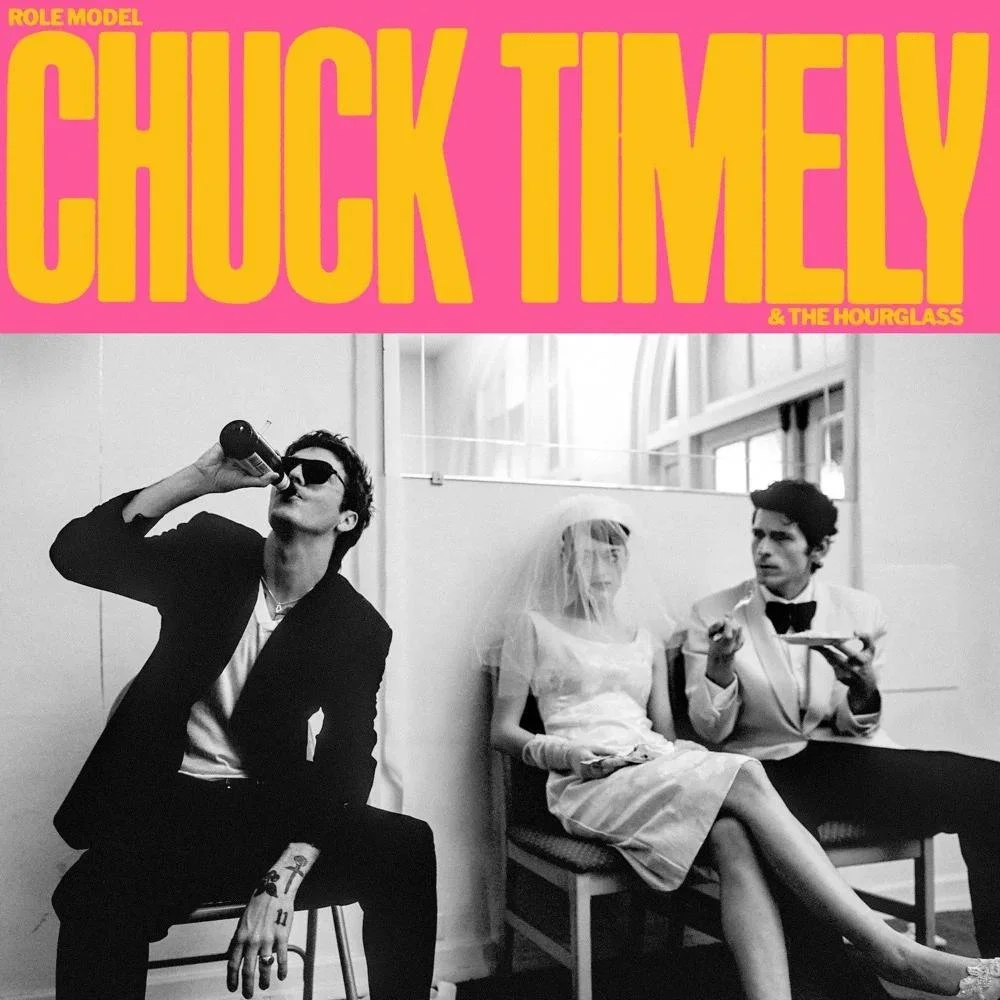
The romantic turmoil that fuels Tucker Pillsbury's third album is wrapped in safe, polished '70s piano rock and tender Americana that rarely strays from the genre's blueprint.
Over the past few years, ROLE MODEL (better known as Tucker Pillsbury) has evolved from an internet cult favorite into a fresh pop darling. Much of that success can be traced back to his effortless charm, amplified through thousands of TikTok videos, as well as the viral breakout “Sally, When The Wine Runs Out”, which not only became a social media phenomenon but also inspired a revolving door of celebrity surprise guests during his live shows. Expectations, naturally, were sky-high. His next release needed to cement his status as a rising pop heavyweight. Instead, Chuck Timely & The Hourglass, his third studio album, only delivers on that promise part of the time.
To accompany the album's rollout, Pillsbury introduced Chuck Timely, a fictional alter ego: a hopeless romantic whose record collection seemingly consists of Fleetwood Mac and The Beach Boys. Yet the character ultimately feels more decorative than essential. Pillsbury himself has insisted this isn't a concept album, and judging by numerous interviews, these songs draw far more from his own experiences than from any imagined narrative. Which raises an obvious question: who exactly is Chuck Timely, and what purpose does he actually serve?
The record opens with “Chuck's Mantra”, a graceful introduction built around soaring choir vocals and church organ. Here, Pillsbury establishes the album's central pursuit: the search for something genuine — something capable of reshaping the reality he's currently living in. That sentiment naturally flows into the buoyant lead single “High Hopes 3000”, an irresistibly catchy slice of piano rock that explores emotional burnout, loneliness, and the exhausting cycle of chasing connection across L.A. nightlife. Throughout the song, ROLE MODEL wrestles with feelings of isolation and emotional paralysis, swinging between flashes of optimism and familiar disappointment. "Does love come around or does one come around to it?" he asks, sounding as though he's lost in the middle of a crowded bar long after midnight.
The following “Song Is All You Get” explores the darker side of that same search, depicting a fleeting romance that disappears after a single night and survives only through memory — and eventually, through song. It feels tailor-made for line dancing in leather jackets and faded denim, reaching its emotional peak during the bridge, where Pillsbury realizes that while his past relationships may not have taught him much about love, they did reveal his true calling: writing songs. He follows it with “Chasing Midnight”, comparing a one-night stand to sunrise after an unbearably hot desert evening. The track aims to capture everything that defines contemporary country-pop radio, yet ultimately collapses under the weight of familiar clichés and an oddly restrained vocal performance.
ROLE MODEL's emotional uncertainty continues on “Good Thing”, an understated ballad where he tries to convince himself that he may have finally found real love. "To my surprise, you're a good thing", Pillsbury sings — only for the infectious “Joy” to arrive moments later and reveal he had mistaken infatuation for something deeper. One of the album's biggest sing-along moments is elevated by a bridge that recalls “Sally”: hear it once, and it'll be looping in your head for the rest of the day. The witty “Service Receipt”, channeling the polished country-pop of Bailey Zimmerman and Kane Brown, finds Pillsbury attempting to move on while kissing someone new and thinking only about the woman he left behind.
There's very little to criticize about Chuck Timely & The Hourglass from a production standpoint. These are beautifully recorded songs that sound warm, polished, and consistently inviting. The real issue lies elsewhere: emotional depth. Pillsbury sings about the beauty of love, the devastation of heartbreak, the frustration of clinging to the past, and the anticipation of new beginnings. Yet emotionally, he rarely shifts gears. The joy of marriage on “The Wedding” barely feels distinguishable from the quiet serenity of “Harmony”. Listening to the album is like cruising down a perfectly paved highway — smooth, comfortable, and almost completely free of surprises.
"Love songs don't come easy", Pillsbury admits on “Love I You”, whose bridge features an appearance from his partner, Dakota Johnson. Ironically, Chuck Timely & The Hourglass is overflowing with love songs in every conceivable form, even when that love is painful or bittersweet. The album's greatest weakness is that, unlike love itself, it rarely embraces emotional extremes. There are no towering highs, no devastating lows, no truly heartbreaking ballads to break its steady rhythm. Songs intended to capture vastly different emotional states often blur together into a single mood. Then again, perhaps that's the point. Maybe finding yourself (and finding peace) doesn't always come with dramatic twists. Sometimes it arrives quietly, one beautifully crafted song at a time.
6.4/10